
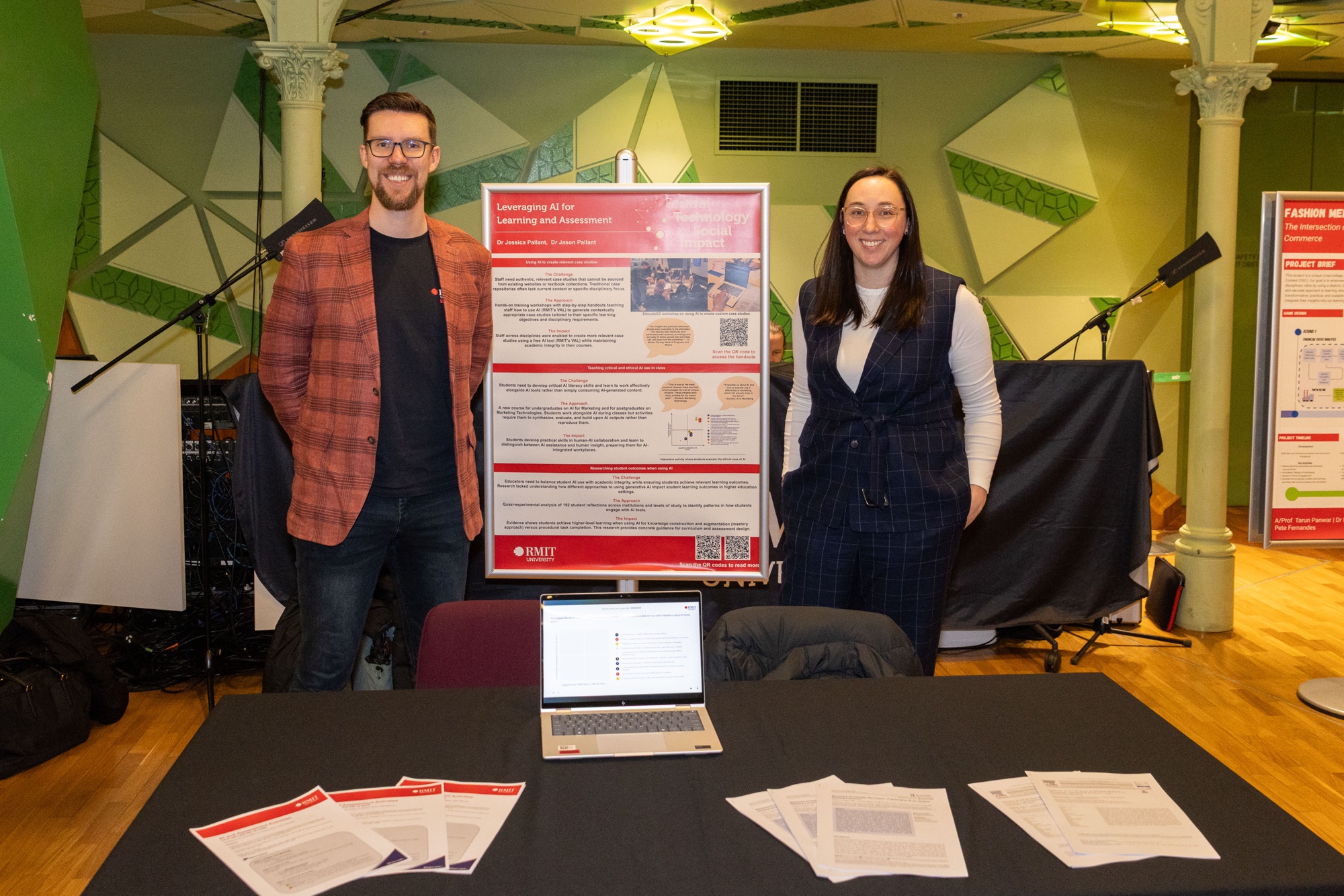
There’s a couple of big themes I’m really passionate about at the moment:
- Finding ways to make tech work for humans, and not just the ones who use it, those on the receiving end too
- Spending as much time as possible with my family
Those two themes unexpectedly came together recently at RMIT’s Festival of Technology and Social Impact (FTSI). FTSI is an annual event where staff across RMIT’s College of Business and Law showcase a range of initiatives utilising tech to make a positive social impact.

Dr Jessica Pallant (who specialises in AI at RMIT and also happens to be my wife) and I were invited to showcase our work on AI literacy for both staff and students.
We showed:
- Our practical workshops for staff to write their own custom case studies
- Activities for students to work with AI critically and ethically, and
- Our various research papers on AI’s impacts.
It was a big honour to be selected as part of our College. We were alongside others who were showing partnerships with industry, to student-built tech, and a range of virtual games.
BUT, being school holidays, and with sick grandparents changing our childcare plans, our 6YO came with us! Thankfully being a tech festival, with very supportive colleagues/ leaders, he had PLENTY of games and ‘toys’ to play with.
He particularly loved the Foodbank game Gillian Vesty, Mila Keightley FHEA and Nicholas Lekakis graciously let him play, collecting various foods while learning where they come from.


Then in the afternoon was the BIG SHOW. Senator Tim Ayres, Federal Minister for Industry and Innovation came to see everything on offer. He talked to staff and students, tested out games and activities and even got into some VR before giving a keynote on the critical importance of innovation and impact beyond ‘productivity’.
Event Details
- Event: RMIT Festival of Technology and Social Impact (FTSI 2025)
- Date: 22 September 2025
- Format: Exhibition showcase booth + ministerial tour
- Venue: RMIT College of Business and Law, Melbourne
- Audience: Federal Minister, academic staff, students, industry partners, families
- Topic/Focus: AI literacy for staff and students; ethical and critical AI use in education
What I Presented
Jessica Pallant and ran a booth showcasing our comprehensive approach to AI literacy. My focus was on demonstrating how we’re building AI capability at multiple levels. We’re not just teaching students to use the technology, we’re helping them engage with it critically and ethically.
We showcased three interconnected initiatives:
- Our practical workshops where staff learn to write custom AI-generated case studies for their own teaching contexts – moving beyond generic examples to discipline-specific, culturally relevant scenarios.
- Our student-facing activities that challenge them to work with AI tools while maintaining critical thinking and ethical awareness.
- Our research foundation, including Jessica’s excellent work with colleagues on mastery mindsets and how they influence learning outcomes when students use AI.
The booth became a conversation hub throughout the day, with colleagues, students, and eventually Senator Tim Ayres engaging deeply with our approach. The materials allowed hands-on interaction rather than passive observation, which created more meaningful discussions about practical implementation.
Key Themes and Insights
- AI literacy requires multi-level intervention: effective programs must address both staff capability and student competence simultaneously
- Custom case study generation democratises high-quality teaching materials: enabling any educator to create contextually relevant examples regardless of their own domain expertise
- Critical and ethical AI engagement matters more than technical proficiency: students need frameworks for evaluating AI outputs, not just skills to generate them
- Research-backed approaches build institutional confidence: grounding educational initiatives in published research creates legitimacy and sustainability
- Cross-generational technology engagement happens naturally: watching a 6-year-old engage with the same technologies being showcased to a Federal Minister highlighted technology’s universal accessibility
Why This Matters
This festival showcased something crucial: universities are moving beyond teaching about AI to modeling responsible AI integration across entire institutional ecosystems. The work Jessica and I presented represents a comprehensive approach. Our research informs teaching, teaching builds staff capability, and staff capability creates sustainable AI literacy.
Senator Ayres’ messages about innovation beyond productivity validated what we’ve been arguing. Technology’s value lies not in efficiency alone but in its capacity to create meaningful social impact. Our AI literacy work exemplifies this: we’re not just making teaching faster or assessment easier, we’re building critical thinking capabilities that students will carry into workplaces and communities.
The festival also demonstrated RMIT’s commitment to making technology research and education accessible and impactful. From AI literacy to First Nations knowledge integration to small business support, the breadth of work on display showed technology as a tool for social good, not just commercial advantage.
Interested in our approach to AI literacy ?
Explore ways to work with me and discuss workshops, research partnerships, and educational initiatives that build critical and ethical AI capabilities.

Leave a Reply