
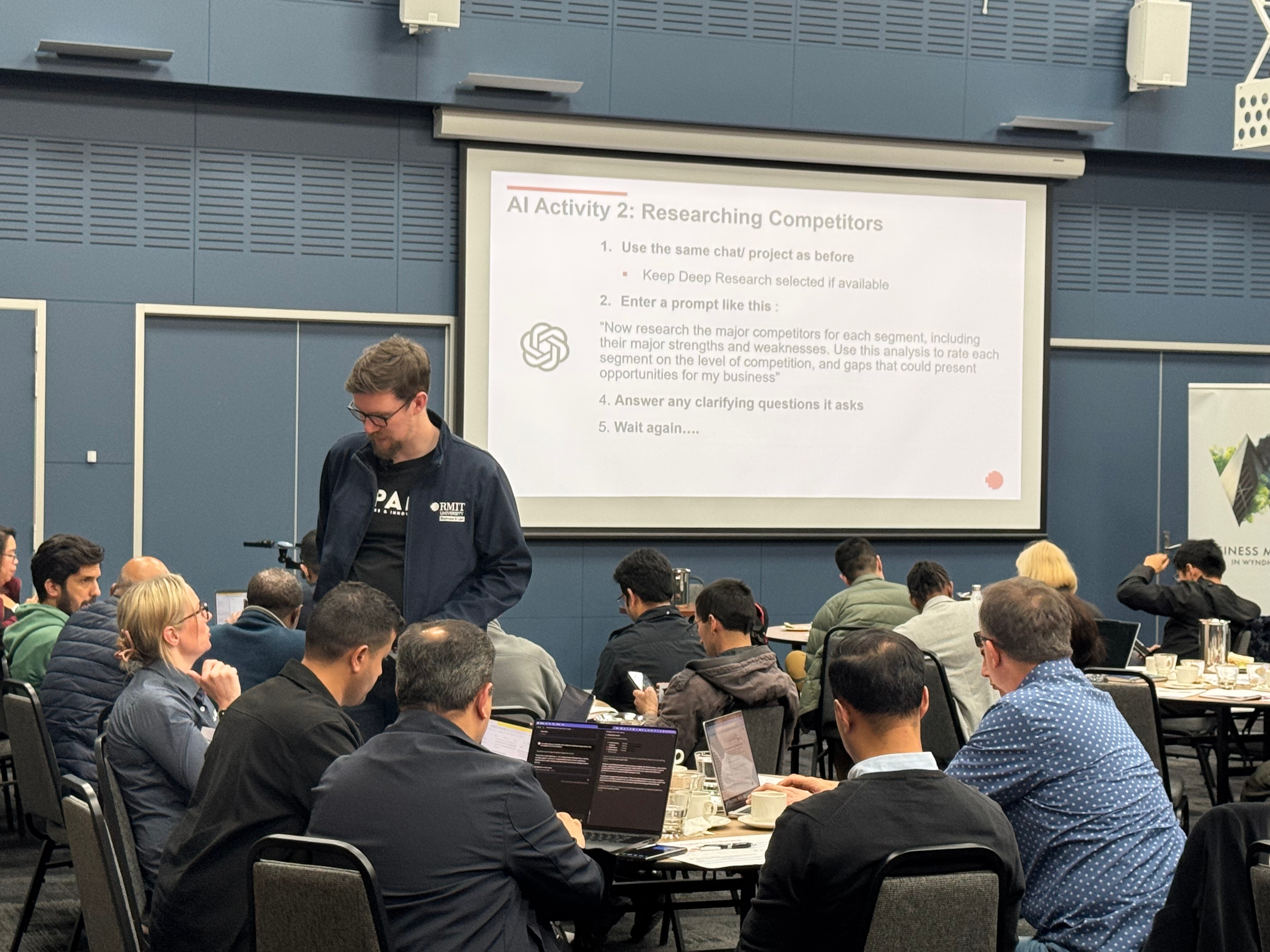
My ‘happy place’ at the moment is making tech accessible and impactful for businesses, particularly smaller ones and those focused on social impact. Last week that was workshops with Ben Desailly for change agents with Sharyn Rundle-Thiele. This week it was hands-on AI skills development for small businesses in Wyndham City Council as part of a Wyndham x RMIT College of Business and Law AI for Business program.

Over 130 small businesses spent their Monday evening learning some simple ways they can use AI to help their business today. I covered:
- Defining a business by value not ‘products’
- Using Deep Research to research customers and competitors
- Finding a business- customer fit
- Developing and testing a value proposition
It was a really phenomenal session. I heard directly from local businesses about what they’re already doing with AI, their daily challenges , and the support they’re looking for. But, the best part was seeing how far they came in just two hours! It was a perfect example of what I’m trying to do; enable MarTech knowledge for everyone involved.
Even better, this is the third session I’ve been part of with the Wyndham x RMIT partnership! More details on this amazing partnership are at https://www.rmit.edu.au/news/all-news/2025/jun/rmit-wyndham-partnership-for-upskilled-business
See the full session recording here:
Thanks to:
- Kennie Robertson, David Gatt and Fides-Mae Santos from Wyndham for inviting me and coordinating on the council side
- David Soderstrom and Kok-Leong Ong for running the RMIT side,
- and Anni Cheng, PhD Kane Koh (Ph.D.), Fuyi Wang, Chaoqi Jia, and JiaHeng Wei for helping out on the night!

Interested in bringing AI and MarTech training to your organisation or community?
Work with me to discuss custom workshops that make technology accessible and immediately applicable for your audience.
Session Details
- Workshop: AI for Business – Practical Tools for Marketing (WyndhamAI for Business Program)
- Date: 20 October 2025
- Format: In-person hands-on workshop
- Participants: 130+ small business owners and operators from Wyndham local area
- Duration: Evening workshop session (approximately 2 hours)
- Location: Wyndham Civic Centre, 45 Princes Highway, Werribee
- Partnership Context: Part of RMIT University x Wyndham City Council AI for Business partnership program
Learning Outcomes
From this hands-on session I wanted participants to:
- Understand how to define their business by customer value rather than just products or services they sell
- Gain practical skills using AI tools like Deep Research to understand their customers and competitive landscape more strategically
- Develop a clear positioning statement that differentiates their business in their local market
- Leave with a trained AI assistant that can create branded content aligned with their unique business positioning and target customers
Learning Design
This wasn’t a theoretical lecture about AI because small business owners need immediately applicable skills, not abstract concepts. So, I designed the session around a business problem that every small business faces: how do I stand out and attract the right customers?
The learning approach used a ‘scaffolded’ learning framework. It built from foundational marketing strategy concepts through to AI application. But, rather than teaching AI tools in isolation, I embedded them within a common value-driven marketing process: segmentation, targeting, and positioning. This grounded the technology in familiar business challenges while demonstrating AI’s practical utility.
The hands-on element was critical. Attendees didn’t just watch demonstrations. They actively used ChatGPT’s Deep Research and Projects features to research their own customers, analyse competitors, and develop their positioning statements. This experiential learning approach meant everyone left with something tangible: a trained AI assistant loaded with their business context, ready to generate branded content!
Key Takeaways
- Small businesses hunger for practical, immediately applicable training – the 130+ attendees who gave up their Monday evening wanted skills they could use Tuesday morning, not theoretical frameworks
- AI adoption barriers are often strategic, not technical – most attendees understood AI tools exist, but struggled with what to ask AI and how to differentiate their content from competitors using the same tools; teaching strategy before tools proved essential
- Context is the competitive advantage – demonstrating how a trained AI assistant produces fundamentally different outputs than generic prompts resonated powerfully; businesses realised their unique positioning becomes their AI edge
- Hands-on experiential learning works for adult professional audiences – attendees engaged far more deeply by working on their own businesses than they would watching generic demonstrations

Leave a Reply